Tag Archive: neoliberalism

Healthy lifestyles: The unfortunate consequences

Healthy lifestyles yoga poseCollectively, increased health consciousness was followed by increased health care costs. The promotion of healthy lifestyles was not the only reason health consciousness increased in the late 20th century. And there were, of course, many other forces at work that increased the costs of health care. But it seems fair to say that the new perspective on health ended up providing opportunities to expand the demand for more medical services. Any hope that individual responsibility for healthy lifestyles would reduce costs – still touted today by some politicians and health care economists — turned out to be a mirage.

Share

Healthy lifestyles: The antecedents

Healthy lifestyles yoga poseIn the 1970s, public health policies began to promote the idea that individuals are responsible for their health and therefore have an obligation to adopt healthy lifestyles. Over the ensuing decades, health became an especially popular topic for media coverage as well as a lucrative market for vendors of health-related products and services. What followed was a substantial increase in health consciousness and greater anxiety about all things that concern the body. Do healthy lifestyles produce better health? That they should may seem like common sense, which is one reason it’s been so easy to promote the idea. The question is difficult to answer with absolute certainty, however.

Share

A more equitable future? US reveals its true intentions

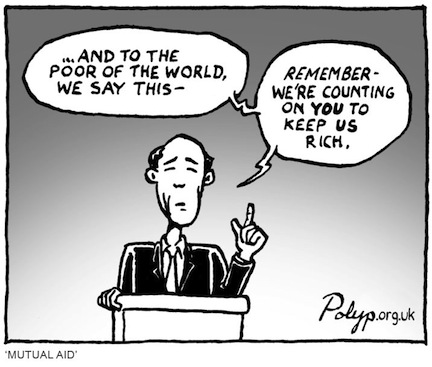
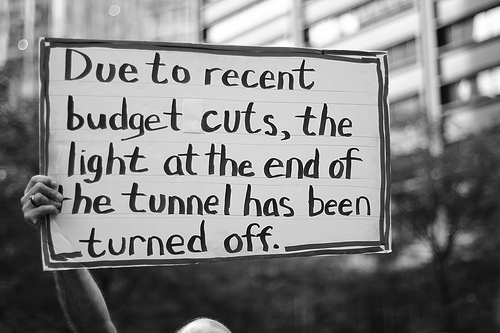
Occupy Wall Street: Light at the end of the tunnelWhy is it so hard to convince policy makers worldwide to address the social determinants of health, including poverty, hunger, and income inequality? Judging by the excerpt below, we shouldn’t count on the US to champion this cause any time soon. It’s from a document called “The Future We Want,” issued by the Rio+20 conference last June. The US requested changes to the document, indicated in bold (additions) and strike-outs (deletions).

Share

On healthism, the social determinants of health, conformity, & embracing the abnormal: (4) The abnormal part

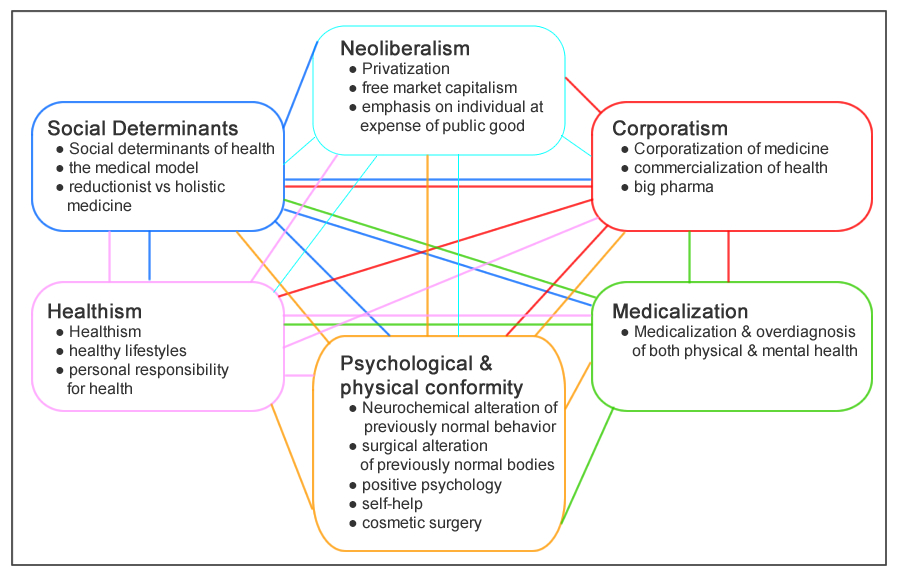
Abnormal psychologyI was initially attracted to the subject of healthism because I felt I’d been a victim of health messaging. But I was also attracted by a sense that something deeper was going on. I now see that the taken-for-granted – the questions that don’t get asked in media coverage of health issues or in the policy positions of governments — unites my blogging topics. In whose interest is neoliberalism? Medicalization? Conformity? Non-holistic medicine? The commercialization of health? Healthism? More often than not the answer is that it’s not in my interest. Nor is it in the interests of the society I want to live in. And that makes these topics personally meaningful to me.

Share

On healthism, the social determinants of health, conformity, & embracing the abnormal: (3) Connections

Blog topics and their connections~ Conformity and corporatism: Surgically altering one’s appearance (e.g., designer feet) presumably increases one’s chance of success in a society that commodifies bodies (i.e., in a society where salary, career advancement, social status and marriage prospects are influenced by appearance). Altering one’s personality with psychopharmaceuticals allows one to project the qualities necessary for success in a highly competitive society.

Share

On healthism, the social determinants of health, conformity, & embracing the abnormal: (2) Economics & the socio-political

Blog topics and their connectionsSocial determinants of health (often abbreviated SDOH) refers to unequally distributed social and economic conditions that correlate with unequal and inequitable distributions of health and disease. Presumably there is a causal relationship between the two, not merely a correlation. Definitively identifying the causal mechanisms, however, is difficult. A great many things influence our health, including things we’re not even aware of yet, and it’s difficult to isolate and scientifically study the ones we can identify.

Share

On healthism, the social determinants of health, conformity, & embracing the abnormal: (1) Bodies, minds & medicine

Blog topics and their connectionsIt’s always hard to be sure about these things, but I think the reason I decided to take a ‘sabbatical’ from blogging last July was that I was interested in too many seemingly unrelated topics. Writing about all of them left me feeling like I never got to the ‘meat’ of any one of them. And I couldn’t convince myself to focus on just one or two things, since that would mean abandoning the others, which I was unwilling to do.

Share

Recommended (online) reading

Woman reading computerI’m still on “sabbatical.” Mostly reading. Thinking about what I most want to write about. I know what my interests are — the problem is, I have too many. Meanwhile, here are some blogs I enjoy reading.

Share

Why are we so willing to undergo cosmetic surgery?

Miss Plastic Surgery finals ChinaMembers of traditional societies accepted being told when and how to reshape their bodies. Their decision was binary: either participate or leave the group. In contemporary society, each individual is responsible for choosing and effecting her own reshaping, thus demonstrating her fitness for membership within a given field. Hierarchical position depends on displaying attunement to the field …. including what kind of body counts as right. The right body demonstrates having made the right assessment of capital, and thus becomes a potent display of rights to participation and position.

Share

Sex, lies, and pharmaceuticals

Sex lies and pharmaceuticals Ray MoynihanMost people experience times when as much as it’s blindingly obvious a problem is not theirs alone, it’s up to them alone to fix it – and a pill is often the quickest or only means.

That’s exactly what Margaret Thatcher and Ronald Reagan wanted us to believe. “There’s no such thing as society.” Unfortunately, many medical distorders do have social, not biological causes. Like poverty.

Share

Feeling sorry for plastic surgeons

sean-mcnamara-christian-troy-plastic-surgeons-nip-tuckThey meant to be reconstructive surgeons, they meant to fix people after horrific accidents or cancer, and they started doing some boob jobs on the side and it started to eat up more and more of their practice because it was so lucrative. They want to send their kids to nice schools, they have mortgages, they have family, and you could see that they felt a little bit helpless as well. It wasn’t what they meant to do. They seemed just as much products of the system as the middle-aged women going in for a facelift or boob job. They were hoping for a better future.

Share

Misc Links 1/17/11

Surgeons at work suicideRates of Suicidal Ideation Among US Surgeons ‘Very Concerning’ (Medscape Today)
1 in 16 (6%) had suicidal thoughts, but very few sought help. Rate substantially higher than general population in surgeons age 45 to 54. Study cites burnout, recent major medical error as risk factors.

British Researcher Wakefield Defends Link Between Vaccine and Autism (ABC News)
What’s interesting here is the second video that comes up, where Wakefield defends himself and accuses Brian Deer – the journalist who accuses him of fraud for financial gain — of using “selective information”

Share

Income inequality and American politics

Winner-Take-All PoliticsUS income inequality is not — or not simply – due to the economic consequences of globalization, like the shift from manufacturing jobs to service sector jobs, with the ensuing loss of pay and benefits. It’s also due to what’s happened in American politics. Business interests — represented by Republicans — have been much better at organizing themselves than have labor unions and interest groups that represent the middle class. And the cost of campaigning – which increased enormously once TV became the dominant campaign medium – has made Democrats willing to support legislation that favors the interests of those with money to spare.

Share

Healthy lifestyles serve political interests

Runner healthy lifestylesUltimately, decisions about a country’s health are not a matter of science, medicine, research, or scholarship. They are essentially political choices. When the US leans right, the solution to the health care crisis is to emphasize personal responsibility (aka prevention through healthy lifestyles). When the country leans left, there’s increased interest in the “negative externalities” of advanced market capitalism (pollution, climate change, ethnic inequities). Neither one is exclusively right or wrong. But when the political climate puts the spotlight on patients who are guilty of unhealthy lifestyles, the focus goes dim on those “fundamental mechanisms leading to disease” that have nothing to do with lifestyle. We lose sight of the genuine solutions that an increased focus on those mechanisms could provide.

Share

The politics behind personal responsibility for health

Reagan and Thatcher danceAnother great example of neoliberal insistence on personal responsiblity: In a 1980 report on the impact of carbon dioxide on climate change – a report requested by Congress – physicist and free-marketer William Nierenberg argued that we should do nothing to prevent climate change because people could simply migrate. “Not only have people moved [in the past], but they have taken with them their horses, dogs, children, technologies, crops, livestock, and hobbies. It is extraordinary how adaptable people can be.”

Share

Water privatization: An investment bonanza

Water faucetFrom Buenos Aires to Atlanta to Jakarta, the liquid everybody needs–and will need a lot more of in the future–is going private, creating one of the world’s great business opportunities. The dollars at stake are huge. … Water promises to be to the 21st century what oil was to the 20th century: the precious commodity that determines the wealth of nations. … To turn a profit, [the privatizing corporation] must collect far more in water charges than it pays out in salaries, equipment, and interest.

Share