The public has a distorted view of science, because children are taught in school that science is a collection of firmly established truths. In fact, science is not a collection of truths. It is a continuing exploration of mysteries.
Doctors sign their names to papers that describe clinical trials of a drug. The papers turn out to be ghostwritten and paid for by the drug manufacturer. The pharmaceutical industry buries any study it doesn’t like, creating the impression that the majority of studies are favorable to what the industry wants us to believe. Journals are biased towards the publication of studies with positive results. All of these practices greatly skew doctors’ opinions of which drugs are effective and safe. Patients die needlessly as a result, and only then does the truth come out in whistle blower lawsuits.
Even supposedly serious economists lend support to these views, arguing that the dysfunctional health-care industry is best left to its own devices. … This is what comes of forgetting the critical role that states have played in nurturing, protecting, and financing their industries, as well as in taxing and taming them. The greatest danger that Western prosperity now faces isn’t posed by any Beijing consensus; it’s posed by the myth of the free market.
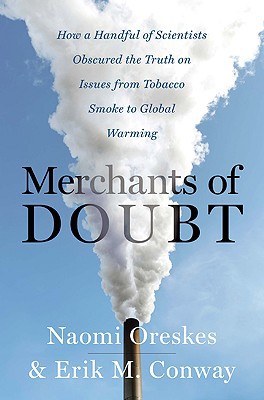
It’s easy to understand – if not condone – the behavior of politicians who are financed by tobacco and oil companies. They oppose the regulation of smoking or pollution because they benefit from the financial contributions of those industries. But what motivates certain scientists to relentlessly cast doubt on peer-reviewed scientific evidence that’s inconveniently contrary to financial interests?
Why are we arguing the issue? Challenging vested interests as powerful as the oil and coal lobbies was never going to be easy. Scientists are not naturally aggressive defenders of arguments. In short, they are conservatives by training: never, ever risk overstating your ideas. The skeptics are far, far more determined and expert propagandists to boot. They are also well-funded. That smoking caused cancer was obfuscated deliberately and effectively for 20 years at a cost of hundreds of thousands of extra deaths. We know that for certain now, yet those who caused this fatal delay have never been held accountable. The profits of the oil and coal industry make tobacco’s resources look like a rounding error.
The gush of filth is a reminder that we have surrendered our independence to a technology we cannot master. … The challenge goes beyond oil slicks and moral revulsion. In the bigger picture, big oil has no long-term future: sooner or later the contemptible little sheikdoms that have arisen upon a pool of liquid greed will sink back into the desert. But why should BP and the emirs script the endgame?
There’s a nice piece in The Atlantic on risk-taking behavior – something that applies to many aspects of life, not just how we treat the environment. (Emphasis added) How do such management disasters occur? The easy answer is, there’s a financial incentive for going forward, and a financial disincentive for holding back. Program managers are…
The South Dakota state legislature recently passed a resolution urging public schools to teach global warming as merely one of many scientific theories, definitely not a proven fact. The resolution cited a number of significant, interrelated dynamics affecting “world weather,” including “climatological, meteorological, astrological, thermological, cosmological, and ecological” factors. It’s a good thing they pointed…
There’s a wonderful letter (PDF) in Science signed by 255 members of the National Academy of Sciences. It’s titled “Climate Change and the Integrity of Science,” and it’s not simply about climate change. It argues that politically motivated attacks on climate change threaten the very integrity of science. As the lead signer points out, since…
Source: U.S. News The American Clean Energy and Security Act of 2009, the House bill sponsored by Rep. Henry Waxman, was passed by the House last June. The Senate bill, called The Clean Energy Jobs and American Power Act, sponsored by Sen. John Kerry, has been languishing in the Senate since its introduction last September….
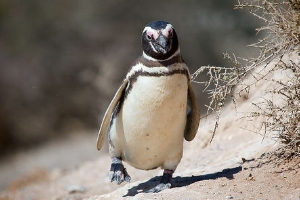
Source: Rehava Penguins, like canaries in coal mines, are a leading indicator of climate change and other environmental hazards. Their frozen habitat is getting smaller. A warmer ocean means the migration patterns of fish have changed, so penguins are forced to travel much farther for food. The Magellanic penguins of South America now need to…