
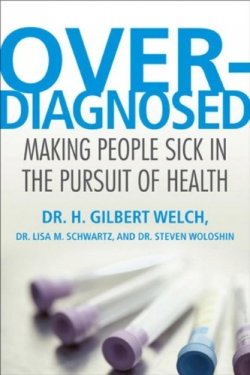
 In his new book, Overdiagnosed: Making People Sick in the Pursuit of Health
Take diabetes. The cutoff point used to be a fasting blood sugar level of greater than 140. In 1997, the number was lowered to 126. This immediately created 1.7 million new diabetes patients.
In a highly publicized study that began in 2003, one group of patients with type 2 diabetes received “intensive therapy” to make their blood sugar “normal.” The control group – the other half of over 10,000 patients – received treatment to lower their blood sugar, but not to the new normal level. The trial was stopped in 2008 when it became clear that there was about a 25% increased risk of dying for the intensive therapy group.
Dr. Welch’s comment on this: “If it’s not good to make diabetics have near normal blood sugars, then it’s not good to label those with near normal blood sugar diabetics. Why? Because doctors will treat them. People with mild blood sugar elevations are the least likely to gain from treatment – and arguably the most likely to be harmed.”
High blood pressure (hypertension) was also redefined in 1997. Instead of the cutoff points being 160 systolic over 100 diastolic, the numbers dropped to 140 over 90. This created 13.5 million new patients.
The definition of high cholesterol (hyperlipidemia) changed following a 1998 clinical trial. The definition of “abnormal” total cholesterol fell from 240 to 200. This created 42.6 million new patients, an increase of 86% over the previous number of patients.
It’s the same with the definition of osteoporosis. A bone mineral density X-ray produces a T score. It’s a way to compare an individual’s bone density to what’s considered “normal.” For women, normal is defined as the bone density of an average white woman aged 20 to 29 (a T score of zero.) If your T score is less than zero, it’s assumed you have an increased risk of fracture.
In 2003 the definition of osteoporosis changed from having a T score less than -2.5 to less than -2.0 (i.e., closer to normal). This created 6.8 million new patients, an 85% increase in those now eligible for treatment with drugs that turned out to have significant side effects – as virtually all drugs do.
Conflict of interest: A much too familiar story
Throughout his book, Dr. Welch tries to be very objective and even handed. Here’s what he has to say about potential conflicts of interest when it comes to setting new cutoffs for disease. (emphasis added)
Cutoffs are set by expert panels of physicians. I wish I could say that their determinations result from purely scientific processes. But they are more haphazard than that: they involve value judgments and even financial interests. …
There are widespread concerns about the independence of the experts who set the cutoffs for these conditions and others. The head of the diabetes cutoff panel was a paid consultant to Aventis Pharmaceuticals, Bristol-Myers Squibb, Eli Lilly, GlaxoSmithKline, Novartis, Merck, and Pfizer—all of which make diabetes drugs. Nine of the 11 authors of recent high blood pressure guidelines had some kind of financial ties—as paid consultants, paid speakers, or grant recipients—to drug companies making high blood pressure drugs. Similarly, eight of the nine experts who lowered the cholesterol cutoff were paid consultants to drug companies making cholesterol drugs. And the first cutoff for osteoporosis was established by a World Health Organization panel in partnership with the International Osteoporosis Foundation—an organization with a corporate advisory board consisting of 31 drug and medical equipment companies.
To be fair, many of these experts may be true believers, people who want to do everything they can not to miss anyone who could possibly benefit from diagnosis. But the fact that there is so much money on the table may lead them to overestimate the benefits and ignore the harms of overdiagnosis. These decisions affect too many people to let them be tainted by the businesses that stand to gain from them.
From healthism to overdiagnosis
Dr. Welch makes an excellent case for the dangers of overdiagnosis. In making that case, he’s up against both entrenched financial and professional interests and a public health campaign that emphasizes prevention and early detection as the be-all-and-end-all for both health and the solution to high health care costs.
Overdiagnosis takes two: the patient population, on the one hand, and the medical profession/medical industry – pharmaceuticals, device makers, etc. – on the other. I suspect that overdiagnosis would not have become standard medical practice if the public had not subscribed to “healthism.”
Healthism is the idea that a correct lifestyle is the key to avoiding disease and that each individual is personally responsible for his or her health (the environment and other corporate externalities be damned). I firmly believe that modifying behavior has less influence on overall health than genetics, social status, economic inequality, and environmental degradation. Understandably, that’s not a message that is welcomed — and it’s not just those with a financial interest in the status quo who oppose it. With so much uncertainty in the world today, ordinary citizens prefer to hold the comforting belief that their health is something they can control.
That’s a big topic for another day. (For many other days, actually.) Understanding how this happened – how and why the public subscribed to the idea of personal responsibility for health — is why I started this blog. Slowly but surely I’m trying to find some answers. A wonderful new book on the subject is Against Health: How Health Became the New Morality
Related posts:
The politics behind personal responsibility for health
Healthy lifestyles serve political interests
The tyranny of health
The last well person
Paging Dr. Frankenstein
Are the most heavily marketed drugs the least beneficial?
Overdiagnosed and overprotected children
The downside of overly aggressive cancer screening
Creating an epidemic of cancer among the healthy
Screening for cancer and overdiagnosis
Should grief be labeled and treated as depression?
The Health Culture: Yesterday. Today. Tomorrow.
Resources:
Image: Squidoo
H. Gilbert Welch, Changing the Rules, Dartmouth Medicine,
H. Gilbert Welch, Overdiagnosed: Making People Sick in the Pursuit of Health
The Action to Control Cardiovascular Risk in Diabetes Study Group, Effects of Intensive Glucose Lowering in Type 2 Diabetes, The New England Journal of Medicine, June 12, 2008, vol 358, pp 2545-2559
Jonathan Metzl and Anna Kirkland, editors, Against Health: How Health Became the New Morality

As a doctor, my only training was seeking disease for better health of people (disease practitiiner).Negative method for positive goal. Incongruent. Now I have turned into a disease and practitioner, seeing health directly (positive psychology etc) and not just looking for disease.
Disease is physical, shorten life. Health is psychological, prolonging life and happiness http://www.ncbi.nlm.nih.gov/pubmed/12150226. I am now a real doctor, a real health practitioner rather than a disease practitioner unknowingly disguised as a health practitioner.
Thank you for your comment, Dr. Cheung. Yes, health is so much more than treating disease after we get sick.
That’s an interesting article you link to: Longevity increased by positive self-perceptions of aging — “This research found that older individuals with more positive self-perceptions of aging, measured up to 23 years earlier, lived 7.5 years longer than those with less positive self-perceptions of aging. This advantage remained after age, gender, socioeconomic status, loneliness, and functional health were included as covariates. It was also found that this effect is partially mediated by will to live.” I’m glad to see the study considered confounders such as socioeconomic status and loneliness.
“Now I have turned into a disease and health practitioner, seeking health directly”
The “overdiagnosis” conclusion is supported by an article In May this year in the British Medical Journal ( http://www.bmj.com/content/344/bmj.e3502 ) – “How to stop harming the healthy”.
Some doctor know that for better health we should seek community factors( http://www.ncbi.nlm.nih.gov/pubmed/21203858 ), but more and more resources are put for doctors to seek disease rather than health.
Health care is a misleading word as society confuse disease care with health care, due to human instinct of fear of disease or death, as if freedom from disease is health. Terminology problem.
50 milliion Americans are not covered by disease care, and the whole country joined to pay for them, but also paying for more disease seeking for everyone simultaneously.
Only when we use the proper correct wording can our society really seek better health rather than disease.
Thank you again for your comments, Dr. Cheung. Yes, overdiagnosis is a problem that needs to be addressed by the medical community, as pointed out by Ray Moynihan in the Lancet article you cite. It’s very encouraging to see that the medical journals are taking this seriously, not only the Lancet but JAMA and NEJM. I give considerable credit for this to the work of H. Gilbert Welch, both his books and his New York Times editorials.
I’m glad to see in the other article you link to (Moving from evidence-based medicine to evidence-based health) that unhealthy community factors are singled out as necessary for improved health.
I applaud the sentiments you express: we must address health at the community level, what we have is disease care not health care, and we all pay for the uninsured. As I put it in my most recent post, medical practitioners are so preoccupied with pulling diseased patients out of the river that they fail to look upstream and ask who’s throwing the bodies into the water.
Keep spreading the word and let’s hope more and more doctors come to understand the situation as you do.
The gist of problem lies in our bio-medical model of disease which arise from Cartesian Dualism philosophy 200 years ago were the mind and body are rregarded as relatively independent, and also from the fact that health and disease are seperately deal with, former by paramedical personnel.
In the last decade, through fMRI, PET scan, Mind body are proven to be anatomically connected (psycho-neuroimmunology 1975, autonomic nerve, neuroendocrine system 1930’s), and that the fact of neuroplasticity (proven in the last few years) tell us that every body has the ability for self healing to a certain extent through controlling their own mind. Such knowledge are kept away from patients for fear that their usual human all or none thinking error will result in delaying of seeking modern medicine advice, which however had gone too far.
Doctors are trained and paid for seeking disease and not for seeking health. People misunderstand as if absence of disease is healthy, even though their minds are under stress which is regarded as normal human and no need for doctor advice.
The gist for medical revolution is restoring the training and paying doctors to look for health and not just looking for disease (unlikely due to paymnet system), mainly to educate the public that they had misunderstood medical care as if it is health care,that they should seek doctors really looking for health (bo-psychosocial model, Engel ,1977).Patients are willing to pay for their own health out of pocket (as noted in flourishing of alternative treatment) if they know that health & disease, mind and body, are all connected and should be deal with simultaneously and not separately .
The British Medical Journal editorial called for moving beyond mind-body split in 2002 ( http://www.bmj.com/content/325/7378/1433.full ) but too many castles had been established within the medical community to protect the mind body split system through specialist system which attracts new medical graduates. The break through should be for patients to looking for doctors who seek health and disease, rather than seeking advice from body-medicine doctors who unconsciously frighten their patients who then turn to alternative therapist who can freely give them peace of mind without legal liability.
Our society now accepts using surgery/procedures for peace of mind. Just look at Warren Buffett who agreed to radiotherapy (with definite chance of complication) for his early prostate cancer which needs only observation.(http://www.npr.org/blogs/health/2012/04/18/150892066/what-we-can-learn-from-warren-buffets-prostate-cancer).
The subconscious mind of patients and doctors are downed with body medicine knowledge and robotized.
Thanks again for your comments, Dr. Cheung. Perhaps what we need is much more education of the public – not just in medical journals – and then let patients vote with their feet.